Reading material by Ken Hollings, <Ideas Are One Thing, and What Happens Is Another>
[Situated Practice] Deep Space 2020 -
[Situated Practice] Deep Space 2020 -
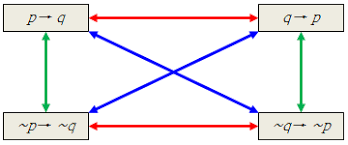
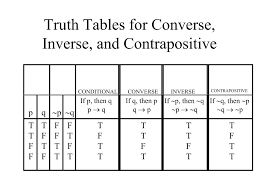
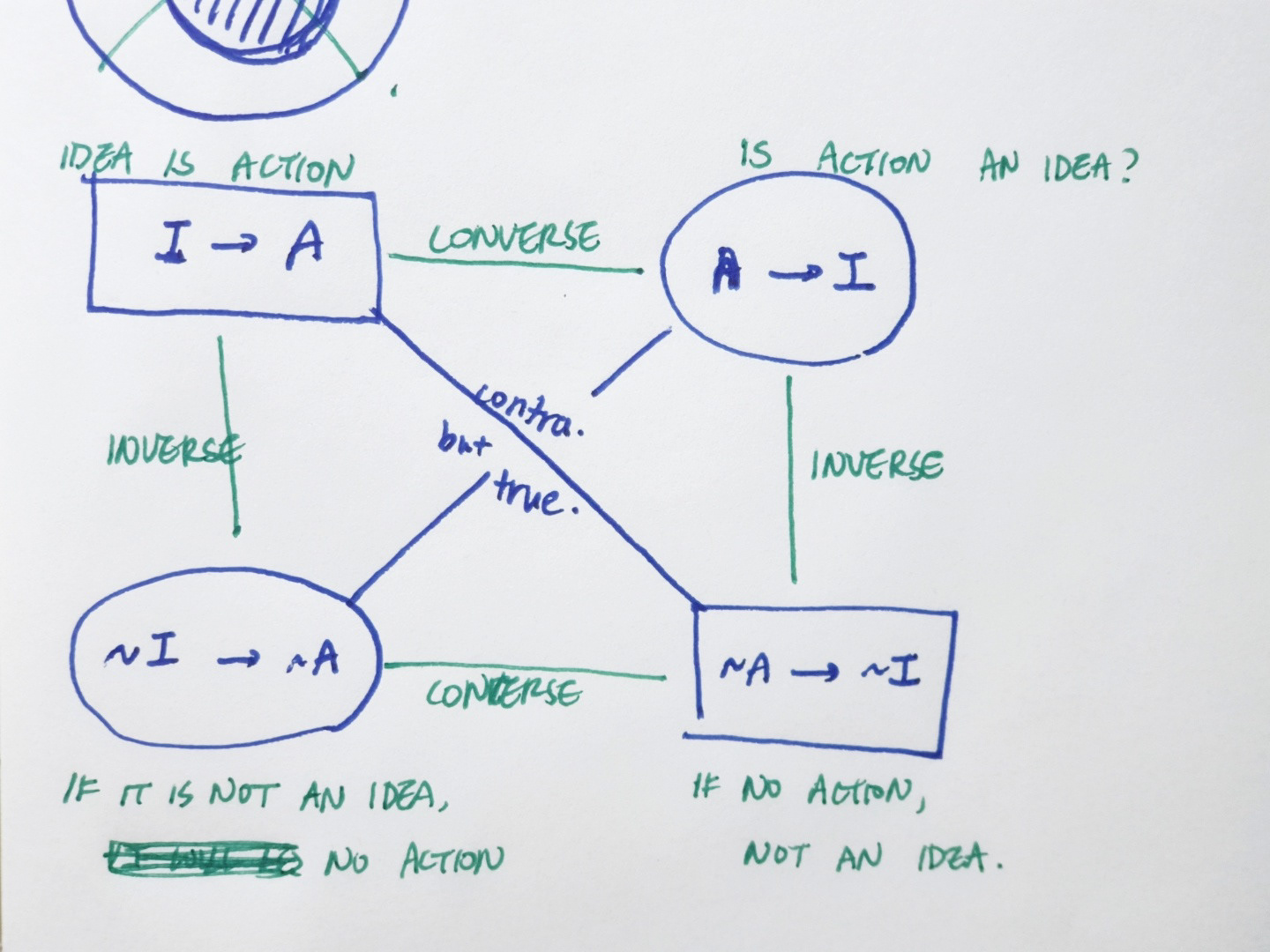
* If [p->q] is true, [~q->~p] is always true.
but [~p->~q] and [~q->~p] may not always be true.
but [~p->~q] and [~q->~p] may not always be true.
Let's start with a statement; assuming it is true.
[if, there is no ACTION, it is not an IDEA]
1. If, [ ~A -> ~I ] is true, contrapositive [I -> A] is true.
= An IDEA is an ACTION.
= An IDEA is an ACTION.
2. Is converse [~I -> ~A] true or false?
'If it is not an IDEA, it is not an ACTION.'
If true, [ A -> I] should be true but this contradicts the proposition No.3.
∴ [ ~I -> ~A ] is false.
-> = Even it is not an IDEA, it can be an ACTION.
'If it is not an IDEA, it is not an ACTION.'
If true, [ A -> I] should be true but this contradicts the proposition No.3.
∴ [ ~I -> ~A ] is false.
-> = Even it is not an IDEA, it can be an ACTION.
3. Is inverse [ A -> I ] true or false?
'An ACTION is an IDEA.'
If true, it contradicts the following statement from the essay;
-> "Thought is not music but music can be thought."
∴ [ A -> I ] is false.
= An ACTION is not necessarily an IDEA.
(Thought = ACTION / Music = IDEA)
4. ∴ IDEA ∈ ACTION but not vice versa.
'An ACTION is an IDEA.'
If true, it contradicts the following statement from the essay;
-> "Thought is not music but music can be thought."
∴ [ A -> I ] is false.
= An ACTION is not necessarily an IDEA.
(Thought = ACTION / Music = IDEA)
4. ∴ IDEA ∈ ACTION but not vice versa.